Client work · Automotive commerce and logistics
One journey. One operational system.
Building AlbSpeed’s digital backbone for vehicle imports across South Korea and Albania.
Importing a vehicle across two continents is not a single transaction. It is a chain of decisions, handoffs and proofs. Cadmus designed and engineered a connected digital service that makes that chain easier to discover, understand, operate and trust—from the first vehicle search to shipping and delivery.

Project
- Client
- AlbSpeed
- Sector
- Automotive commerce and logistics
- Markets
- South Korea ↔ Albania
- Engagement
- Product strategy, UX/UI, full-stack engineering, integrations and support
- Surfaces
- Public web, vehicle platform, dealer workflows and operations
- Status
- Live
- Automotive Logistics
- Commerce
- Operations
- Integrations
- Albanian Business
A service spanning two continents needed to feel like one system.
AlbSpeed coordinates a vehicle-import journey that begins in South Korea and ends with a customer or dealership in Albania. Between those points sit discovery, auction access, cost evaluation, inspection, purchase, export documentation, sea freight, customs and delivery.
The business already had the human network and operational knowledge to manage that journey. The digital challenge was to turn it into a service people could read: one that gave a first-time buyer confidence, gave a dealer enough structure to move quickly, and gave the operating team clearer surfaces for the work behind every order.
Cadmus approached the project as an operational system, not a collection of pages. The result connects public explanation, vehicle inventory, auction discovery, landed-cost guidance, quote requests, VIN-based shipment visibility, dealer workflows and internal operations under one coherent product language.
“The interface is not separate from the logistics operation. It is how the operation becomes understandable.”
The product begins where certainty ends.
Buying a vehicle locally is already a high-consideration decision. Importing one from another continent adds distance, unfamiliar data, changing costs and a series of physical and administrative handoffs. The buyer may encounter a listing in one place, an auction record in another, a shipping update somewhere else, and the actual operating team through calls or messages.
That fragmentation creates a trust problem before it creates a software problem. A customer is not only asking whether a vehicle is attractive. They are asking whether the source can be understood, whether the total cost is credible, whether somebody is accountable for the next step, and whether the vehicle remains visible after payment.
AlbSpeed’s opportunity was to make its real-world capability legible online: not to pretend that international logistics is simple, but to show how the complexity is controlled.
A vehicle-import platform cannot promise certainty everywhere. It must make uncertainty legible.
One journey, different users, different levels of detail.
The same import process looks different depending on who is using it. A private buyer needs orientation and reassurance. A dealership needs fast comparison, pricing context and repeatable sourcing. An operator needs status, identifiers, exceptions, documents and accountable handoffs. A public website cannot simply expose an internal dashboard, and an internal dashboard cannot be designed like a marketing page.
The system also sits across changing external data and physical events. Vehicle availability changes. Auction states move. Shipping data arrives from another provider. Customs and tax calculations require care. Some steps can be automated; others still depend on human inspection and judgment.
Our challenge was therefore architectural as much as visual: create role-specific surfaces that share one understandable operating model, while keeping each surface focused on the decision in front of its user.
Condition and product response
| Operational condition | System response |
|---|---|
| Operational condition Vehicle discovery is spread across listings and auction sources. | System response Give inventory and auction discovery a consistent search, filter and comparison language. |
| Operational condition The listed vehicle price is not the cost of receiving it in Albania. | System response Put indicative landed-cost context before commitment and route final pricing through a real quote. |
| Operational condition A physical shipment can disappear from the customer’s digital view. | System response Use the VIN as a durable lookup key and expose the shipping state through a focused tracking flow. |
| Operational condition Private buyers and dealerships move at different rhythms. | System response Use shared product logic with a dedicated dealer pathway for volume sourcing and recurring coordination. |
| Operational condition Critical work continues behind the public interface. | System response Support the operating team with structured internal surfaces rather than forcing the process back into scattered messages and sheets. |
Design the journey before designing the screens.
We organized the product around the actual import journey: choose, price, source and inspect, ship and clear, then deliver. That sequence became the shared mental model across the public website and the platform.
This changed the role of each interface. The website had to explain the service and establish accountability. Inventory and auctions had to support evaluation. The calculator and quote flow had to clarify cost without presenting an estimate as a guarantee. Tracking had to answer one urgent question without unnecessary navigation. Dealer and operations tools had to support repeated work and exceptions.
The important design decision was not to force every capability into one overloaded dashboard. AlbSpeed became a connected family of surfaces, each with a clear job and a recognizable system behind it.
Operating principles
The whole journey over isolated features
Every screen should make sense as part of the path from selection to delivery.
Transparency at decision points
Costs, status, provenance and next actions should appear where uncertainty is highest.
Human judgment stays visible
Inspection, approval and support are not hidden simply to make the product appear more automated.
Shared logic, role-specific surfaces
Customers, dealers and operators should recognize the same process without receiving the same interface.
The import journey
5 stages, one continuous service.
- 01
Choose
Explore ready-to-order inventory or auction opportunities.
- 02
Price
Understand indicative landed cost and request a vehicle-specific offer.
- 03
Source and inspect
Coordinate purchase or bidding and complete the relevant inspection.
- 04
Ship and clear
Move the vehicle, follow shipping context and coordinate customs.
- 05
Deliver
Complete the handoff in Albania with the required documentation.
A connected digital service, not a single website.
Cadmus designed and engineered AlbSpeed as a set of coordinated product layers. The public layer explains the service and turns interest into a concrete next step. The commerce layer exposes vehicles and auction opportunities. The logistics layer handles quotes and shipment visibility. The partner layer gives dealerships a repeatable sourcing path. The operations layer supports the people coordinating the work.
Each layer can evolve without breaking the customer’s mental model. New inventory sources, shipping integrations or operational capabilities can be added behind the same sequence because the product architecture follows the service rather than a temporary page structure.
Product layers
Trust layer
Explain what AlbSpeed controls, what the customer decides and what happens next.
- Service website
- Process explanation
- Contact and quote entry points
Commerce layer
Turn a large and changing vehicle market into a focused decision environment.
- Ready-to-order inventory
- Auction discovery
- Vehicle detail and evaluation
Logistics layer
Make price formation and the physical journey visible at the moments they matter.
- Landed-cost guidance
- Shipping quote
- VIN shipment tracking
Partner layer
Support repeat buyers with a workflow designed for volume, margin and cadence.
- Dealership onboarding
- Target-based sourcing
- Candidate approval and reporting
Operations layer
Give the team structured control behind the public promise.
- Internal operations UI
- Order and status coordination
- Vehicle and VIN context
Turn inventory into a decision environment.
A large inventory is only useful when people can narrow it with confidence. AlbSpeed’s ready-to-order surface lets buyers search and filter by the attributes that shape a real purchase: price, year, mileage, power, body type, fuel type and market type.
Auction discovery adds a different rhythm. Availability and results change over time, so the interface separates source, auction week and outcome while preserving the same core vehicle filters. The experience is built for scanning first and deeper evaluation second.
The design avoids pretending that a card contains the whole truth about a vehicle. Search results help users form a shortlist; vehicle details, inspection context and direct support carry the decision forward.
Show how the price becomes a landed cost.
The price attached to a vehicle abroad is not the price of receiving it in Albania. Shipping, duty, VAT and service costs change the decision. Hiding that structure until a sales conversation creates unnecessary friction; presenting an estimate as a binding answer creates a different kind of risk.
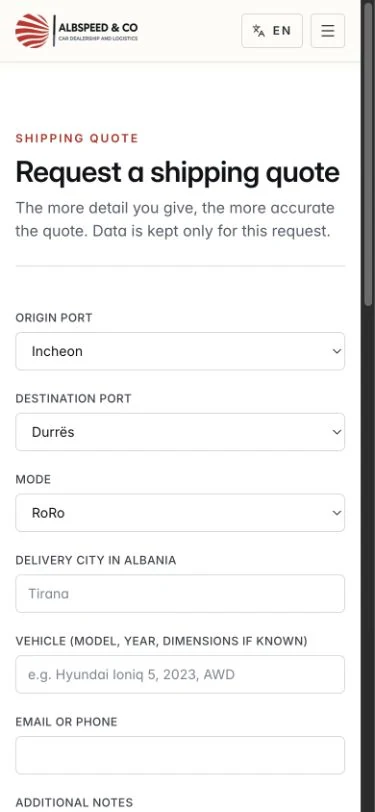
We designed the landed-cost experience to sit between those extremes. It exposes the major components, makes the estimate easy to read and labels its limits. The final offer remains tied to a real vehicle and order, where the team can validate the details responsibly.
The quote flow then gathers the information that affects an actual shipment—origin, destination, shipping mode, delivery city and vehicle details—without demanding an account before the customer can express intent.
“Transparency is not showing every number. It is showing the right number with the right level of certainty.”
Keep the vehicle visible after the interface becomes physical.
The most important part of the journey eventually leaves the screen. The vehicle moves through ports, vessels, documents, customs and local delivery. That is precisely when the digital service must not go silent.
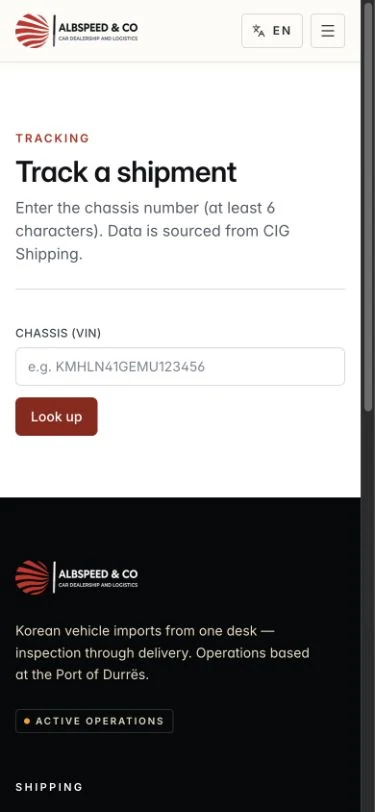
AlbSpeed’s tracking flow uses the VIN—the identifier already attached to the vehicle—as the customer’s lookup key. The interface is intentionally narrow: enter the VIN, retrieve the shipment context, understand the current state. Public tracking data is sourced from the identified shipping provider, while AlbSpeed remains the operational point of contact around the broader journey.
The surrounding shipping experience explains the route, opens a structured quote request and keeps contact information close. The product does not replace the logistics team; it gives customers a clearer window into the work that team coordinates.
Operational ports referenced by AlbSpeed
A schematic of the ports named on AlbSpeed’s public shipping surfaces, not a fixed vessel itinerary.
- Origin ports
- Incheon · Pyeongtaek · Busan
- Destination ports
- Koper · Durrës
Design repeat work differently from a one-time purchase.
A dealership is not simply a customer buying more cars. It works against stock rotation, target models, budgets, margins and recurring reporting. The dealer pathway therefore frames AlbSpeed as a sourcing partner rather than a catalogue.
The workflow moves from verification and monthly targets to candidate vehicles, approval, execution and reporting. It makes cadence part of the product: the dealership communicates what it needs, AlbSpeed turns that into structured sourcing work, and both sides have a clearer basis for the next decision.
Behind these public and partner-facing surfaces, Cadmus also developed operational interfaces for the AlbSpeed team. The goal was not to automate away expert judgment. It was to give that judgment a structured place—connected to vehicles, identifiers, order states and the next accountable action.
Keep evidence close to the purchase decision.
A vehicle can look right while still carrying unanswered questions. The AlbSpeed product family was extended to support branded VIN and vehicle-report workflows that place identity, inspection and history context closer to the moment of evaluation.
This layer is designed as evidence, not decoration. It should make the vehicle being discussed unambiguous, distinguish source data from AlbSpeed’s own assessment, and give the buyer a report that can be revisited or shared without losing its context.
The same principle runs through the wider platform: trust is strongest when the proof belongs to the object, price or status it explains.
Serious enough for logistics. Clear enough for a first-time buyer.
Automotive interfaces often lean toward either glossy aspiration or dense dealer software. AlbSpeed needed a third position: commercially confident, operationally credible and easy to read on the phone a customer already uses during a sales conversation.
The visual system uses strong hierarchy, controlled contrast, disciplined spacing and repeated interaction patterns. Vehicle imagery carries emotion; pricing, status and process information remain sober. Primary actions are unambiguous, while secondary detail stays available without competing for attention.
Mobile layouts prioritize search, filters, contact and status. Larger screens use their space for comparison and operational density. Across both, the interface uses the same vocabulary for vehicles, costs and states so the product becomes easier the longer someone works inside it.
Interface rules we held to
- Use hierarchy to reduce explanation.
- Keep status and next action together.
- Use vehicle imagery as evidence, not background decoration.
- Differentiate estimates, confirmed values and unavailable data.
- Design empty, loading and failure states as part of the service.
- Prefer familiar repeated patterns over screen-by-screen novelty.
Where trust is actually carried
- Provenance A vehicle arrives with its source context—market type, auction source and the record behind the listing—rather than a price alone.
- Inspection The published process keeps inspection as a visible step instead of implying that evaluation is fully automated.
- Cost context Landed cost is separated into vehicle price, shipping, duty, VAT and AlbSpeed services, and labelled as indicative until a real order exists.
- Shipment status A VIN lookup returns shipment context, with the tracking-data source named on the page rather than implied.
- Accountable handoff Quote requests and contact routes stay close to every stage, so the next step belongs to the AlbSpeed team rather than to the interface.
Build for changing data and real operational consequences.
The platform sits between customer intent, third-party vehicle data, auction states, shipping information and AlbSpeed’s own operating process. Those boundaries are not perfectly stable. Data can be incomplete, delayed or formatted differently by its source. A production system must make those conditions explicit rather than letting them leak into confusing screens.
Cadmus treated integrations as contained boundaries: validate incoming data, normalize it into a product model, preserve source identifiers, define loading and failure behavior, and keep provider-specific logic from spreading through the interface. High-consequence actions and calculations remain distinguishable from informational estimates.
The architecture was shaped for extension. Public acquisition, customer tools, dealer workflows and internal operations can evolve at different speeds while retaining shared concepts and visual language. That matters more than a fashionable stack: the system has to remain maintainable as routes, providers and operating volume change.
AlbSpeed now has a digital structure that matches the service it operates.
The work gave AlbSpeed more than a new public presence. It created a coherent path from discovery and evaluation to quotation, shipment visibility and delivery support—alongside dedicated structures for dealerships and the operating team.
Customers can understand the process before starting it. Vehicle and auction discovery share a consistent language. Cost is introduced with the right qualification. Shipping remains visible through a VIN-centered lookup. Dealers enter through a workflow designed for repeat sourcing. AlbSpeed’s team has clearer operational surfaces behind those promises.
No single screen is the outcome. The outcome is that the screens now belong to the same operating model. That gives AlbSpeed a durable base for new inventory sources, logistics integrations and service channels without rebuilding the customer journey every time.
What the project delivered
One legible customer journey
Discovery, cost guidance, quotes, tracking and delivery support read as stages of the same service.
Trust built into decisions
Provenance, inspection, price qualification, status and human accountability appear where uncertainty is highest.
B2C and B2B without fragmentation
Private buyers and dealerships receive different workflows while retaining the same underlying product logic.
Operations behind the promise
Internal tools connect the customer-facing experience to the work required to fulfill it.
A base designed to extend
The system can accept new sources, integrations and channels without discarding its core journey.
These are delivered capabilities and structural outcomes, not quantified performance claims.
Public surfaces you can open today
Live AlbSpeed surfaces from the delivered system. Internal operations tooling stays private.
Trust is a system property.
In a high-consideration service, trust does not come from adding a badge to the homepage. It comes from preserving context across the entire journey: what a vehicle is, where information came from, what a number includes, which stage the shipment has reached, who is responsible and what happens next.
The AlbSpeed project reinforced a principle central to Cadmus’s work: software for real operations should not hide complexity with theatre. It should organize complexity so that customers and teams can act with more confidence.
That is the difference between a digital brochure and digital infrastructure.
“Trust is not a section on the page. It is what remains consistent from the first search to the final handoff.”
Scope
- Digital product strategy
- Service and information architecture
- UX and interface design
- Public website development
- Vehicle inventory and auction experiences
- Landed-cost and quote flows
- Shipping and VIN tracking integration
- Dealership workflows
- Internal operations tooling
- Deployment and post-launch support
Designed and engineered by Cadmus for AlbSpeed.
AlbSpeed and its marks belong to their respective owner. Third-party platform and provider names, where shown, belong to their respective owners.